
Just swipe to mark "got it / forgot it." An SRS (spaced repetition) algorithm based on the forgetting curve serves the words you should review next, at the optimal time. Open it in your browser; no sign-up, start memorizing today.
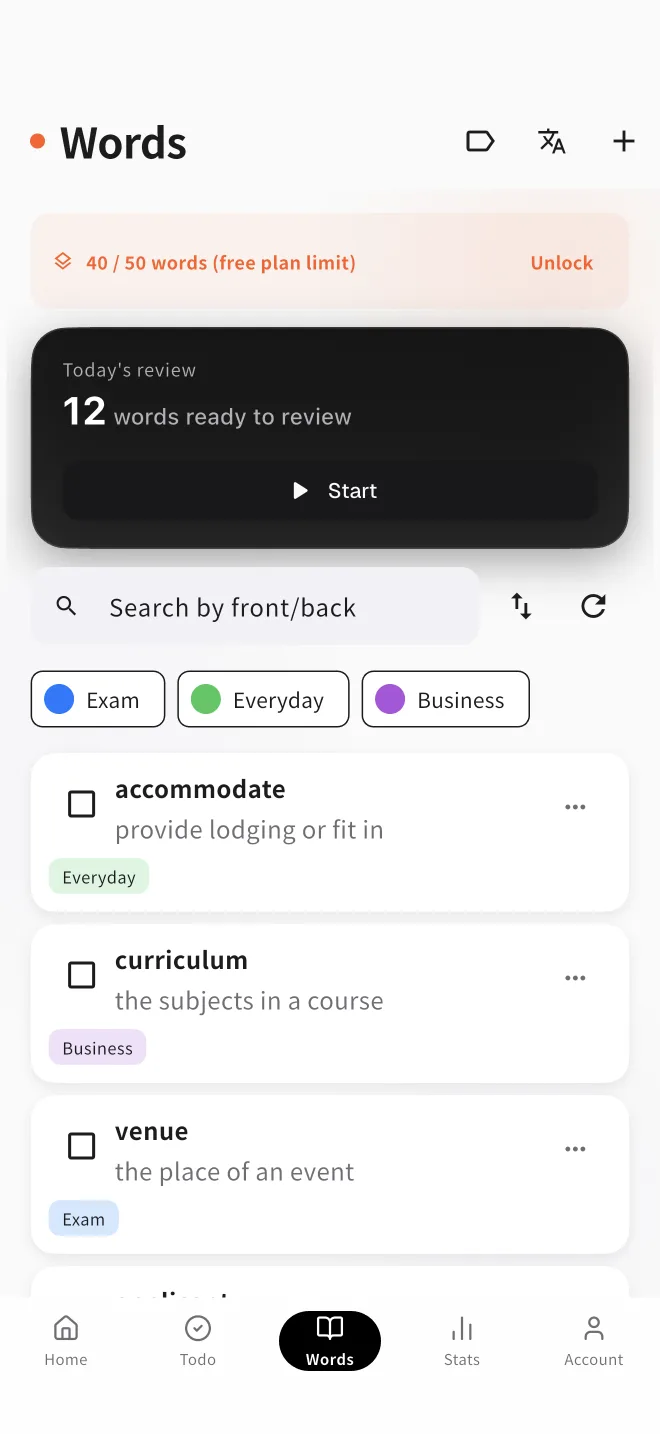
Create, flip, review. Just the actions memorization needs, in the fewest steps.
Flip a card and record "got it / forgot it" with a swipe. Keep a brisk rhythm going.
The next review date adjusts automatically based on how you did. Cards appear just as you're about to forget, boosting retention.
Sort words by tag — vocabulary, terms, exam prep — and manage them efficiently.
Cards you create are saved automatically. Log in and review the same deck from where you left off across devices.
Struggling to memorize words isn't about talent — it's about review timing. Here's how memory works and how to study efficiently.
Since the experiments of psychologist Hermann Ebbinghaus, we've known that memories fade fastest right after learning and then decline gradually — the forgetting curve. Cramming that evaporates overnight is simply how memory works. The fix is to design your reviews around the assumption that you will forget.
Reviews work best right as you're about to forget. When recalling takes a little effort, the memory comes back stronger and lasts longer next time. Spaced repetition (SRS) stretches the interval step by step — 1 day → 3 days → a week — so you reach long-term memory with fewer reviews. MonoStudy's flashcards compute these intervals automatically from your rating of each card.
Trying to retrieve an answer from your own head strengthens memory far more than rereading it — the testing effect. Before flipping a card, always say the answer yourself first, then check. That one habit dramatically changes retention.
Reviews get heavier the longer you postpone them. Keep each session short, but clear the cards served each day, every day. Track it with the study timer and watch your streak grow, and vocabulary review becomes a daily routine.